The successful management of patients with cleft lip and palate
deformity requires a multidisciplinary approach. Historically,
cleft lip and palate care starts with treatment modality of presurgical
infant orthopaedics (PSIO). However, the necessity of
presurgical orthopaedics in managing the resulting orofacial deformity
is the discussion to ponder upon due to the variety of
methodologies available and results produced by these devices. The
objectives of this paper were to review the journey of PSIO
appliances so far, basic principles of PSIO treatment, the various types
of techniques and the protocol followed, and to critically
appraise the advantages and disadvantages of these techniques. In
conclusion, we believe that PSO treatment, with its objective to
approximate the segments of the cleft maxilla may reduce the
intersegment space in readiness for the surgical closure of cleft sites.
Keywords: Cleft lip and palate; presurgical infant orthopaedics; PSIO
Abbreviations: PSIO: Presurgical Infant Orthopaedics; CLP: Cleft Lip and Palate; NAM: Nasoalveolar Molding; DMA: Dentomaxillary
Advancement Appliance; UCLP: Unilateral Cleft Lip and Cleft Palate
Introduction
Cleft lip and palate (CLP) are the most common congenital
malformation caused due to variation in development of facial
structure during gestation [1]. The incidence of patients with CLP
is about 1.7 in 1000 live births globally [2]. The incidence is highest
in Afghan population as 4.9 and lowest in Negroid population as 0.4
per 1000 live births [3,4]. The presence of cleft involving lip, palate
and alveolus results in disfigurement and distorted growth and
development. There is wide presentation of facial features among
patients depending upon the severity of the cleft. A wide nostril
base, separation in the upper lip of the cleft side is the characteristic
feature of unilateral cleft defect. There is lateral and inferior
displacement of affected lower lateral nasal cartilage which results
distortions in the anatomic form of nose, tripod tilt in skeletal
structure, a depressed dome, increased alar rim and deformities in
apex of nostril. Shift in the base of the nose, deviation of septum
to non-cleft side is also seen in patients with CLP. The separated
premaxilla may overhang from the maxilla with variation in size
[5,6]. Supervision and management of patients with CLP is a process
that begins in infancy and continues in adulthood. Early treatment
in the form of Presurgical Infant Orthopaedics (PSIO) is required
to reduce the cleft width and to help maxillary arch development,
thereby improving occlusion, feeding, speech, hearing, and
language development and aesthetics [6,7]. PSIO has been defined
as “use of forces to reposition tissues secondarily displaced due to a
cleft deformity” [8]. Active and passive orthopaedic appliances have
been developed for correction of CLP defect by using compressive
& tensional forces or passively guiding growth. The aim of PSIO is to
decrease the width of the cleft gap, to achieve a favorable alignment
in the cleft segments within the initial few months of infancy prior
to cheiloplasty, and to allow surgical repair with minimal tension
[9]. In addition, there is improvement and ease in feeding, increased
fluid intake, subsequently weight gain, improvement in functioning
of tongue, reduced risk of aspiration and reduction in severity of
dental & skeletal deviations.
Various methods and treatment protocol have been developed
over ages and suggest PSIO prior to the primary surgery in patients
with CLP for better surgical aesthetic results and prevent the social
stigma. The aim of this review is to sum up the history, evolution,
efficacy, advantages, disadvantages, complications, recent advances
of different PSIO appliances, and critically analyze the evidence as
well as the current status of PSIO.
Historical Perspective
PSIO has been a part of treatment strategy used in the
management of patients with CLP for centuries. As early as in
1556, detailed explanation of the indications, surgical technique,
and post-operative care of the cleft lip has been documented. A
technique involving lip repair with cleft lip pins has been described
by Amboise Pare in 1575. However, it was in the year 1689,
Hoffmann demonstrated the use of facial binding to narrow the
cleft and thereby prevent postsurgical dehiscence. The technique
of retraction of the maxilla before surgical repair in patients with
bilateral CLP was introduced in 1790 by Desault [10,11]. Adhesive
tape binding usage in presurgical preparation was popularized
by Hullihen [12]. Brophy in 1927 clinically demonstrated that
silver wire passing cleft alveolus can be gradually tightened to
approximate the alveolus before lip repair [13]. The modern school
of presurgical orthopaedic to mould the alveolar segments using a
series of plate system with active forces was introduced by 1950
McNeil [14] later popularized by Burston. Cupid’s bow and the
philtrum symmetrical correction as Millard’s rotation advancement
closure technique was introduced by Millard in1960 [15]. A pinretained
active appliance which could simultaneously help in
retraction of premaxilla and expansion of the posterior segments
was introduced by Georgiade and Latham in 1975 [16]. The use of a
passive orthopaedic plate for slow alignment of the cleft segments
was described by Hotz in 1987 [17]. Matsuo’s (1988-91) series of
research on molding of neonatal nasal cartilage and nostril with
the help of silicone tubes was the gateway to invent newer modern
methods [18-20]. The paradigm shift in the PSIO treatment was
with the introduction of Nasoalveolar molding (NAM) by Grayson
and Cutting in 1993, a novel technique in which presurgical molding
of the alveolus, lip and nose is carried out in infants born with CLP
[21].
Objectives of PSIO
Literature has highlighted the objectives of PSIO: to stimulate
growth of patalal shelves, upper arch development, improvement
in the projection of nasal tip leading to overall growth of the face. It
also facilitates improvement in occlusion, feeding, speech, hearing,
and language development. Eventually, PSIO aim at achieving a
more uniform osseous base. The achievements of these objectives
facilitate surgical closure and improve the final aesthetic result [22-
25].
Classification of PSIO appliances
PSIO appliances can be classified into active and passive
appliances based of force application (Table 1). Active appliances
act by active forces being applied on the separated alveolar
processes for growing them into desired anatomic position. The
various appliances used for PSIO are discussed below and the
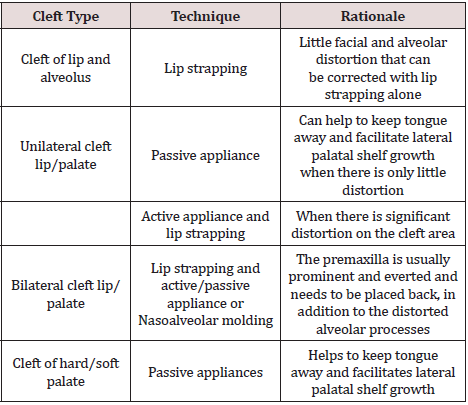
technique of PSIO in different cleft types is summarized in Table 2.
Table 1: Classification of PSIO appliances.
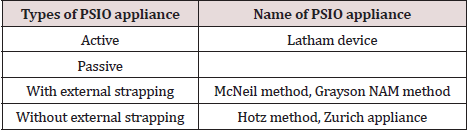
Table 2:PSIO techniques in different cleft types.
Lip taping
Approximation of the alveolar segments within 5 mm of each
other can be managed by using Lip taping. In this technique medical
adhesive tape such as Steri-strips® is placed across the upper lip in
the first week of life following which skin adherent dressing such as
Tegaderm ®, are placed over the area of the cleft lip. Elastic forces
will exert a retracting, backward pressure against the protruding
premaxilla, improve their positions and allow definitive lip skin
repairing. The clinical effectiveness of Lip taping is documented,
however with only limited studies [26].
McNeil method
The pioneer work for alignment of the alveolar parts presurgical
for patients with CLP was done by McNeil, who believed that a
normal position of maxilla, alveolar & palatal cleft segment can
be achieved by molding and approximating segments into correct preplanned position using a series of appliances. This method not
only stimulated soft tissues to grow in cleft region but also modify
the postnatal development of the maxilla. This method was further
popularized by Burstone, an orthodontist. The advantage of this
method is that a smaller number of appointment are required,
hence encourage patients who may have to travel long distances for
treatment [14,27].
Latham appliance
The Latham appliance also known as the Dentomaxillary
Advancement Appliance (DMA) was developed to align the
alveolar arch through rapid orthopedic correction and alignment
of cleft segments was introduced by Dr Lantham and Georgiade
[16,28]. Latham based his treatment concept on the facial growth
hypothesis of Scott [29,30] with aim of the procedure ‘to carry the
interrupted embryonic process to normal completion’ by maxillary
alignment, stabilization of the alignment along with tunneling of the
alveolar cleft with periosteum, and reconstruction of the nasal floor
to support the alar base. This appliance is an active pin-retained
appliance fixed surgically to the bone for patients with age around
2 to 5 months. The appliance works by simultaneously applying
pressure to the cleft segments over a 4 to 6-week period to move
the alveolar segments into proper position, which is followed by
alveolo periosteoplasty and lip adhesion. According to Drs. Latham
and Millard, these alignments allow the performance of gingiva
periosteoplasty (GPP), providing stabilization of the maxillary
segments and reconstruction of the nasal floor [31]. Greater values
for cephalometric measurements in maxillary length, maxillary
prominence and ANB angle has been found for patients treated
with this appliance [32]. However, other authors have concluded
that this appliance did not affect dental arch relationships in
preadolescent children [33]. The problem associated with
procedure is that, besides neonatal maxillary orthopedics, infant
periosteoplasty is always performed, although it is more limited
with less undermining of periosteum on the maxilla.
Hotz appliance
In Europe, the treatment principles of McNeil for neonatal
maxillary orthopaedics were greatly modified by grinding away the
acrylic in specific areas to bring out necessary alignment, known as
Hotz appliance (Zurich approach). According to Hotz and Gnoinski,
the primary aim of presurgical orthopedics is not to facilitate
surgery or to stimulate growth, as postulated by McNeil, but to take
advantage of intrinsic developmental potentials. In Zurich approach
lip operation is performed at the age of 6 months while palate
repair is postponed until 5 years of age [34,35]. The appliance is
made of hard acrylic or a combination of hard and soft acrylic: it
passively covers the alveolar segments and extends slightly into the
area of the cleft and the buccal sulci. This appliance assists with
both bottle-feeding and to allow some breast-feeding in infants with CLP. Harmonization in the vertical and transverse positions
of the cleft segments has been found with Hotz plate therapy [36].
Long-term effects of the Hotz plate and early lip adhesion have been
studied by several researchers and it has confirmed that arch width
and length of the anterior part of the maxilla improves better than
other treatment options [37]. Similarly, the two-stage palatoplasty
in combination with application of the Hotz’ plate has good effects
on the maxillary growth than one stage palatoplasty without Hotz
plate [38].
Nasoalveolar molding
Earlier PSIO appliances were designed to correct the alveolar
cleft only, despite the fact that the nasal deformity among these
patients remains the greatest esthetic challenge. Grayson [21,39]
described a new technique to presurgical mould the lip, alveolus
and nose in infants born with CLP. The concept of naso alveolar
molding (NAM) works on Matsuo’s principle; [18-20] that the nasal
cartilage could be molded due to increased plasticity concurrent
to increased levels of maternal estrogen if treatment is initiated
within 6 weeks of life. The NAM appliance consists of an intraoral
molding plate with nasal stents to mould the alveolar ridge and
nasal cartilage concurrently. Beside other advantages of traditional
plates, the main objectives of NAM appliances are improving nasal
symmetry and lip aesthetics while elongating the columella and
correcting nasal cartilage deformity. Hence, a less extensive surgery
is required for the lip and nasal repair, and there is less tension
on the reconstruction, greater nasal symmetry is be obtained
after cleft lip repair using NAM therapy as well as better lip form,
reduced oronasal fistulas and labial deformities, and a namely a
60% reduction in the need for secondary bone grafting [24].
Objectives of NAM in unilateral cleft lip and cleft palate (UCLP)
The main objective of NAM for UCLP is to reduce the severity
of the original cleft deformity by reducing the width of the
alveolar cleft segments and alignment of the base of the nose and
lip segments [21]. Taping the lips together helps in correction of
the inclined columella upright along the mid-sagittal plane. As
the lower mid-face skeletal elements (alveolar ridge and lower
maxilla) improve in relation to each other, the overlying soft tissue
improves concurrently. The alar rim, which was initially stretched
over a wide alveolar cleft deformity, shows some laxity that enables
it to be elevated into a symmetrical and convex form. The nasal tip
on the cleft side is overcorrected in its forward projection; this is
achieved through the use of a nasal stent, an intra-oral acrylic plate,
and surgical tapes [39-44].
Objectives of NAM in bilateral cleft lip and cleft palate cases
The main objective being the non-surgical elongation of the
columella and also to center the pre-maxilla, along the mid-sagittal
plane, retraction of the pre-maxilla in a slow and gentle process to
achieve continuity with the posterior alveolar cleft segments.
Reduction in the width of the nasal tip, improved nasal tip projection
and increase in the nasal alar base width [21,39,43].
Benefits of NAM
Proper alignment of lip, nose and alveolus is achieved, thereby
enabling surgeons for better surgical repair of the cleft deformity
and hence reduce post-surgical breakdown [42,43]. Approximation
of alveolar process before surgery also enables surgeons to perform
gingivo-periosteoplasty successfully. NAM provides stable change
in nasal shape with less scar tissue and better lip and nasal form.
It also reduces the number of surgical revisions for excessive scar
tissue, oro-nasal fistulas, nasal and labial deformities, due to proper
columellar elongation and lengthening. With the alveolar segments
in a better position and increased bony bridges across the clefts, the
permanent teeth have a better chance of eruption in a good position
with adequate periodontal support [39,40].
Complications of NAM
a) Locked-out segments: It may occurs due to the poor and
un-volunteered molding process, wherein the greater segment
moves more rapidly, without the change in position of the lesser
segment, as a result, the lesser segment gets locked out behind
the greater segment.
b) Nostril overexpansion (Mega-nostrils): This occurs when
the nasal stent application is started before the size of the cleft
gap is adequately reduced. The premature nasal stenting exerts
excessive force against the nasal tissue leading to excessive alar
expansion and resulting in mega-nostrils.
c) Tissue ulceration: It occurs due to application of pressure
by the intra-oral acrylic appliance, which may be due to ill-fitting
appliance. At times the area under the horizontal prolabium
band may also get ulcerated, if the band is too tight.
d) Skin ulceration: It may result due to frequent application
and removing of tape, resulting in irritated and ulcerated skin
over the cheek region.
e) Dislodgement of the acrylic plate: It is the complication
which may result in obstruction of the airway. This can only
occur, if the arms of the appliance are taped too horizontally or
with inadequate activation [39-44].
Prevention of the complications associated with NAM Therapy
a) NAM therapy must be closely monitored and volunteered
at timely basis with adequate application of mechanics and
robust principles of the therapy must be followed.
b) Tissue expanding direction and associated mechanics
should be monitored vigorously and nasal stenting should
commence only after the cleft gap is reduced by minimum 6
mm and softer denture liner must be covered over the nasal stent tip, so as to apply gentle forces.
c) Tissue ulcerations can be prevented by coating of tissue
lubricant over the appliance before insertion into the oral
cavity.
d) Skin ulcerations over the cheek region can be prevented by
using Duo-derm or Tega-derm, underneath the tape strapped.
e) Parents must be thoroughly educated to continue the use
of NAM appliance for their child until the therapy lasts. Feeding
instructions must also be given accordingly.
f) Motivating the parents to visit the dentist on scheduled
appointments and in timely manner is of utmost importance for
a successful NAM therapy [39-44].
Modifications
Recently NAM appliance has been modified by different authors
in many ways. It includes modified muscle-activated maxillary
orthopaedic appliance [45], incorporation of expansion screw
[46], dynamic presurgical nasal remodeling intraoral appliance
design [47], extra-oral nasal molding appliance [48], self-retentive
appliance with orthodontic wire [49,50], use of TMA wire instead
of SS wire for making nasal stent [51] and the latest technique of
OrthoAligner “NAM” [52] & NAM custom aligners [53].
DynaCleft ® and Nasal Elevators
DynaCleft® is a premade nasal and alveolar molding device
which can be used to successfully mold the upper lip, alveolus and
nose prior to cleft lip repair. Traditional surgical adhesive tape (e.g.
Silk tape, Steri-strips®) have been used in the past, unlike tape,
DynaCleft® offers the benefit of being able to provide a constant
approximation force with an elastic centre that allows it to conform
to a baby’s mouth better because of its ability to expand and contract.
Additionally, the controlled force provided to the prolabium
and premaxilla could improve surgical results and decrease the
necessity of early lip adhesion surgery. As the DynaCleft® device
is pre-made; there is no need to create custom-made devices for
the molding process. Studies have shown that with the use of
DynaCleft® with a nasal elevator has produced results similar to
that of NAM therapy. However, unlike the NAM appliance, it does
not require adjustments with growth of the infant. Nasal elevators
have been found to improve the shape of the nose and alae, thereby
reduce the need for primary surgery to the nose in patients with
UCLP. Due to its elastomeric core and stretch property, DynaCleft®
allows the infant to feed and cry without limitation.
Conclusion
Many orthodontists working on patients with CLP have shown
great enthusiasm for PSIO to improve surgical outcomes with
minimal intervention. Although different forms of PSIO appliances
are available, it seems that NAM therapy has been especially popular in all over the world. Undoubtedly, every orthodontist or
surgeon aims to use the best treatment modality for their patients.
Nevertheless, PSIO effects can be confounded by surgical type and
timing of the primary repair, as is discussed in many studies. In
such cases, one should be cautious when evaluating the particular
outcomes for patients with CLP since it is difficult to differentiate
the sole effect of an individual surgical or orthodontic intervention.
Read More Lupine Publishers
Pediatric Dentistry Journal Articles:
https://lupine-publishers-pediatric-dentistry.blogspot.com/