Objectives: This study was performed to understand such chief
complaints through scaling operation performed by dental
hygienists, as bleeding, or instrument sensation for dental patients and
how to improve by explain the control method of them, in
order to supply the better operation in the future and contribute the
improve for the patient’s oral health.
Subjects and Method: Thirty five female dental patients who had
received the scaling from 35 dental hygienists were
participated in this clinical study, from the periods on March, in the
year 2020 at G city, and the questionnaire method was performed
with such questions as chief complaints after scaling with Likert 5
scale scores.
Results: The complaints or merits after scaling were examined
as followings as bleeding complaint was 3.51±1.29 points,
hyper-sensation of the tooth was 3.74±1.26 points, tooth crack or
fracture as 2.68±1.18 points, abrasion as 4.02±1.15 points,
possible for eating hot and hard foods as 3.20±1.32 points, early detect
of caries as 2.17± 0.92, points, chance for consultation about
implant or denture as 3.22±1.19,, possible for drinking acidic beverage
as 3.20±1.32,points , possible for finding enamel hypoplasia
as 2.20±1.23, points and possible for removal of filling or
prosthodontic materials as 2.88±1.30 points. The evaluation of dental
hygienist for the hand instrument manage skill is revealed as 4.11±1.10
points for supra-gingival calculus removal, 2.51±1.29 points
for sub-gingival calculus removal, 4.17±0.95 points for using 1~2 mm
lateral surface of scaler blade, 2.77±1.23 points for using
the back surface of the scaler blade, 2.60±1.11 points for start scaling
after demonstration with the tip guide. 3.22±1.35 points for
grasping scaler slightly and insert it around the tooth as like as probe
use, 3.14±1.37 points for vertical movement with slow motion
of the tip along the long axis of the tooth on sub-gingival area,
2.88±1.34 points for using scaler tip with slight pumping touch at the
tooth surface, 3.48±1.33 points for moving the blade vertically with
inserting it on col area and 2.94±1.34 points for put the scaler
tip locate beside the proximal area of the neighbor tooth on scaling at
proximal area.
Conclusion: The abrasion or hypersensitivity were the big complaints from patients on scaling and dental hygienists were
evaluated as high score in such item of scaling skills as supra-gingival calculus removal and using 1~2 mm on lateral surface of
scaler blade, but got the least score in such item on sub-gingival calculus removal.
Keywords: Dental Scaling; control dental; dental hygienist; pain; dental calculus
Introduction
The periodontal care can be performed through such method
as the non-operative periodontal treatment, operation and scaling
or oral prophylaxis and professional mechanical tooth cleaning.
Non-surgical periodontal care is aims for diminishing the gingival
inflammation and eliminate the periodontal pocket through the
removal of dental plaque and calculus surrounding the tooth,
in order to re-attach or re-generation of the periodontal tissue.
Moreover, it can be done as a pre-treatment procedure for severe
periodontal surgery through performing the removal of plaque and
calculus, polishing the root surface, applying the chemical therapy
or occlusal re-adjustment. On the other hands, surgical periodontal
treatment can be determined as operation surrounding gingival
tissue through incision or excision of the periodontal tissue. It
can be operated the calculus removal and root planning through
the security of operating sight and re-forming of the gingival out line
form through the suture after operation, in order to easy
success for oral hygiene [1]. Scaling can be defined as the removal
of plaque and deposit calculus on the tooth surface as well as the
removal of tooth stain as caffeine or nicotine, in order to diminish
the micro-organisms or changing the compositions at sub-gingival
area, to result for prevention of periodontal disease by eliminating
the etiology of tooth loss, as an effective method for periodontal
disease. Periodontal disease is one of the most popular dental
disease in the world-wide and dental hygienist is one of the proper
dental workforces to manage the periodontal disease through
performing the preventive cares as scaling. it should be needed for
expert skill for scaling for dental hygienist and one pf the skill check
would be instrumentation skill check for them at each potion of
detailed areas at oral portions, because of elimination or diminish
the oral micro-organisms through the removal of calculus or plaque
by expert scaling. Although the scaling is a good measure to prevent
periodontal disease, there has been revealed such complaints from
the patients as hypersensitivity of the tooth, gingival bleeding,
pain, abrasion of the cervical area of the tooth, removal of the
filling or prosthodontic materials and the operators have to find
their chief complaints to notice them to patients or do their best
to avoid it with careful skills on scaling. It would be a good way
for operator as dental hygienist to learn and training the bleeding
control or stopping method before scaling about the procedure and
anatomical structure of the blood vessel in the oral cavity or blood
pressure control method or drug of choice as using Epinephrine
derivatives or Bosmin agent. Another complaints or side effect from
the scaling should be understood for operators in order to diminish
them to perform the successful scaling. The aims of this study have
been suggested to understand the chief complaint or oral status
changes as well as checking and evaluation the operators scaling
skill done by dental hygienist, in order to supply more safe and
expert operation to dental patient in the future.
Subjects and Method
Subjects
Thirty five dental hygienists who have been working at dental
clinics at Gwangju city, Korea were participated in this study for
checking the scaling skill and also 35 dental patients who has
visited dental clinic and received the scaling by 35 dental hygienists
were joined to ask for chief complaint or side effect after scaling.
Method
This questionnaire method of examination was performed
after achieved the certification for IRB (Institutional Review
Board) from Bio ethic committee of Honam University as number
as 1041223 201912-HR 18. Self-evaluation for managing the
hand instrumentation skill of scaling by-themselves with using
the 5 scaled score evaluation sheet after scaling, at Kwangju city
on March in the year 2020. 10 questions such as supra-gingival calculus removal, sub-gingival calculus removal, using 1~2 mm
lateral surface of scaler blade, using the back surface of the scaler
blade, adjusting tip guide for scaling. grasping scaler slightly and
insert it around the tooth as like as probe use, vertical movement
with slow motion of the tip along the long axis of the tooth on subgingival
area, using scaler tip with slight pumping touch at the tooth
surface, moving the blade vertically with inserting it on the cervical
area and putting the scaler tip insertion with proper location at the
proximal area of the neighbor tooth on scaling at proximal area.
Also 35 of their patients for scaling were joined to be asked for some
complaints or side effects of scaling with use of 9 questions such
as bleeding complaint, hyper-sensation of the tooth,, tooth crack
or fracture, abrasion, possible for eating hot and hard foods, early
detect of caries, chance for consultation about implant or denture,,
possible for drinking acidic beverage, possible for finding enamel
and possible for removal of filling or prosthodontic materials, by
supplying the questionnaire sheet. The data was collected through
the calculation of average mean points and standard deviation with
5 points as full score for each question and compared and analysis
with their points with statistical analysis. Data were analyzed by
use of the computer program as SPSS 18.0 for the data of mean and
standard deviation with t value and significance, for 5 points of full
score for each question.
Result
General characteristics for subjects
(Table 1). Through the general characteristics for patients of
this study, the oral hygiene level was 3.00± 0.72 points, gingival
bleeding was 1.20± 0.40 points, tooth-brushing level was 2.37±
0.49 points and the frequency of scaling was examined as 1.22±0.42
points. The average age of the subjects was 45.25±9.45 years old
(Table 2). The complaints or merits after scaling were examined
as followings as bleeding complaint was 3.51±1.29 points, hypersensation
of the tooth was 3.74±1.26 points, tooth crack or fracture
as 2.68±1.18 points, abrasion as 4.02±1.15 points, possible for
eating hot and hard foods as 3.20±1.32 points, early detect of
caries as 2.17± 0.92, points, chance for consultation about implant
or denture as 3.22±1.19,, impossible for drinking acidic beverage
as 2.80±1.32,points, possible for finding enamel hypoplasia as
2.20±1.23, points and possible for removal of filling or prosthodontic
materials as 2.88±1.30 points (Table 3). The evaluation of dental
hygienist for the hand instrument manage skill is revealed as
4.11±1.10 points for supra-gingival calculus removal, 2.51±1.29
points for sub-gingival calculus removal, 4.17±0.95 points for using
1~2 mm lateral surface of scaler blade, 2.77±1.23 points for using
the back surface of the scaler blade, 2.60±1.11 points for adjusting
tip guide for scaling. 3.22±1.35 points for grasping scaler slightly
and insert it around the tooth as like as probe use, 3.14±1.37 points
for vertical movement with slow motion of the tip along the long
axis of the tooth on sub-gingival area, 2.88±1.34 points for using
scaler tip with slight pumping touch at the tooth surface, 3.48±1.33
points for moving the blade vertically with inserting it on the
cervical area and 2.94±1.34 points for put the scaler tip insertion
with proper location at the proximal area of the neighbor tooth on
scaling at proximal area.
Table 1: General characteristics for patient subjects (n=35, full score =5.0points).
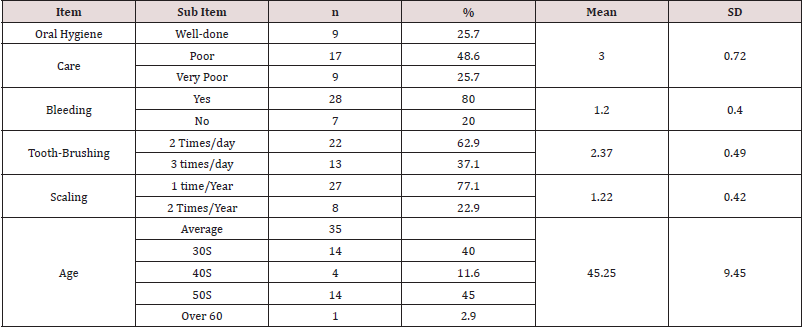
Table 2: Patient’s complaint the oral and habitual state changes after scaling. (Full score=5.0 points, n=35).
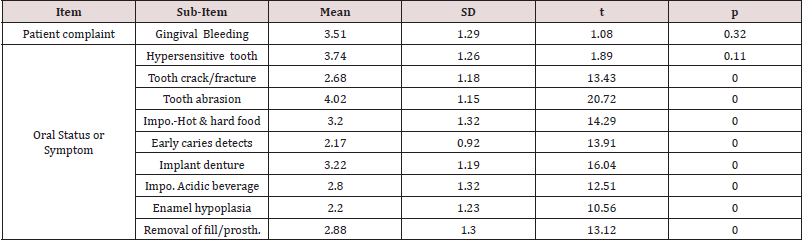
Impo.: Impossible for eating, Impo. Acidic beverage; Impossible for drinking acidic beverage, Prostho: Prosthodontic appliance
material.
Table 3: Self-evaluation points for the skill of the hand instrumentation for scaling done by dental hygienist.
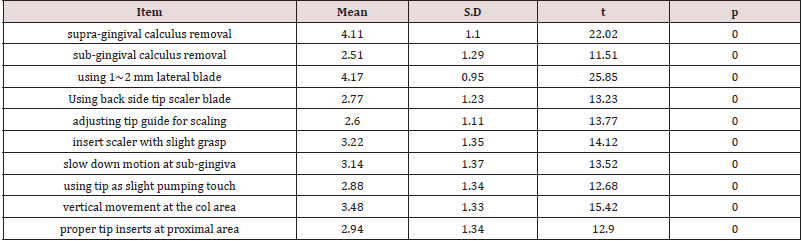
( n=35, full score =5.0 points).
Discussion
Scaling and root planning are very important for dental
treatments. Scaling is a process eliminating plaque, calculus,
necrotic tissue and so on, and root planning makes root surfaces of
infected teeth smooth after scaling. Scaling and root planning reduce
the number of sub-gingival pathogenic organisms, and they return
unhealthy sub-gingival to a healthy state; therefore, they promote
healing of periodontal tissue by inducing epithelial tissue attached
to root surface. Until now, the studies about the effectiveness of
hand and powered instruments for scaling and root planning, the
influence on changes in the root surface and dentin hypersensitivity
after periodontal treatment have been conducted. The differences
of studies about the effectiveness of various instruments for scaling
and root planning and the influence on changes in the root surface
were shown by a type of instrument, sharpness, the experimental
method of in vivo and in vitro, time and the frequency of strokes,
pressure on the instruments and the contact angles. Table 1 showed
the general characteristics of patients of subjects and the oral
hygiene state was 3.00± 0.72 points in 5.0 points of full score as
appraised as normal state of oral hygiene. It was distributed as 9 as
25.7% in well state, 17 persons as 48.6% in poor and the rest 9 as
25.7% in severe poor state. Gingival bleeding score was checked as
1.20± 0.40 points as much subjects were found as bleeding. 80.0%
of them have bleeding as usual and 7 persons as 20.0% of them had
no bleeding at all before scaling. Tooth-brushing level was checked
as 2.37±0.49 points estimated as general level and the frequency
of scaling level was as 1.22± 0.42 points as low level. The average
age of them was 45.25±9.45 years old as middle-aged group. This
study was performed for checking patient’s complaint for scaling or
some symptoms or side effect from receiving the scaling, and these
data from the patients would be contribute to understand them
and to minimize the complaint or side effect for scaling by dental
hygienists in the future. Recently, a various oral application method
has been studied like varnish using mucus which is mixed 5% NaF
with colophony resin [2].
Age and oral health consciousness affect its importance [3] oral
health disorder Ju et al. [4] reported that the coverage of insurance
coverage twice a year and the expansion from the high school level
would be more appropriate than the current one. Oral health beliefs
about the level of beneficial effects of toothbrush behavior were
higher for subjects who wore toothbrushes three times a day and
wore toothbrushes before going to bed [5]. Recently, it has been
recognized that the symbiotic status of bacteria in the oral cavity
is important because bacterial diversity is maintained, rather than
antibacterial concept which reduces microorganisms themselves
[6]. Table 2 showed that the complaints or merits after scaling
were examined as followings as bleeding complaint was 3.51±1.29
points, hyper-sensation of the tooth was 3.74±1.26 points, tooth
crack or fracture as 2.68±1.18 points, abrasion as 4.02±1.15 points,
possible for eating hot and hard foods as 3.20±1.32 points, early detect
of caries as 2.17± 0.92, points, chance for consultation
about implant or denture as 3.22±1.19,, impossible for drinking
acidic beverage as 2.80±1.32,points , possible for finding enamel
hypoplasia as 2.20±1.23, points and possible for removal of filling
or prosthodontic materials as 2.88±1.30 points. It means that
the important chief complaints of scaling patients were gingival
bleeding and hypersensitivity after scaling. It could be occurred the
gingival bleeding through irritating the inflammatory gingiva on the
time of the removal of calculus and hypersensitive dentin could be
occurred by removal of calculus which would be a role of protection
from outer irritation as cold or hot air or water, at the cervical area
of the tooth surface. it needed to let patient understands this theory
of bleeding and hypersensitivity through the oral education before
scaling. The other symptoms were revealed as better after scaling
than before, at large or a little bit. Anyway, patient education to
inform the side effect or symptoms should be done to dental
patient for scaling before operation. Park et al. [7] emphasize that
the oral health belief on level of beneficial impact according to the
toothbrush behavior was higher for the subjects with toothbrush 3
times a day and toothbrush before going to bed.
The evaluation of dental hygienist for the hand instrument
manage skill is revealed as 4.11±1.10 points for supra-gingival
calculus removal, 2.51±1.29 points for sub-gingival calculus
removal, 4.17±0.95 points for using 1~2 mm lateral surface of scaler
blade, 2.77±1.23 points for using the back surface of the scaler
blade, 2.60±1.11 points for adjusting tip guide for scaling. 3.22±1.35
points for grasping scaler slightly and insert it around the tooth as
like as probe use, 3.14±1.37 points for vertical movement with slow
motion of the tip along the long axis of the tooth on sub-gingival area,
2.88±1.34 points for using scaler tip with slight pumping touch at
the tooth surface, 3.48±1.33 points for moving the blade vertically
with inserting it on the cervical area and 2.94±1.34 points for put
the scaler tip insertion with proper location at the proximal area
of the neighbor tooth on scaling at proximal area. From the results,
dental hygienists could well perform the elimination of the calculus
at the supra gingival deposition otherwise hard for sub-gingival
portion. it should be training more and re-examination system for
remnant deposition of calculus would be recommended to educate
on training cause. Also, it revealed high score for using side surface
of the scaler blade but low score to use a back side of scaler blade
on scaling. It revealed average 2.5 points to 3.5 points for all check
items. It means that the most dental hygienists could perform the
scaling with middle leveled or a little bit high leveled ability and left
some upgrade in the future. it would be recommended to training
repeatedly for dental hygienists to operate scaling with one step by
one step periodically.
Conclusion
This study was performed with questionnaire method about
the patient’s complaint for scaling and self –evaluation for hand
instrumentation skill done by dental hygienist in order to deliver the
operation with improvement in the future. 35 dental hygienists
who have been working at dental clinics in Kwangju city and 35 their
scaling patients were participated in this study. The questionnaires
for complaints or side effects were checked for scaling patients
and hand instrumentation skills were checked for self-evaluation
for dental hygienists after scaling. From the results, the obtained
conclusion was as followings.
a) It was revealed that the main complaints after scaling
were gingival bleeding and hypersensitive dentin and the
others were not so big leveled problems.
b) Dental education for patient’s complaints or side effects
should be done before scaling operation in order to minimize
the patient’s complaints.
c) Dental hygienists have done well for removal of supragingiva
calculus deposit and using 1~2 mm lateral surface of
scaler blade, but not so high leveled score in the other items, left
to be improvement.
d) Periodic training for dental hygienist should be needed
to remind and to improve the hand instrumentation skill for
scaling.
Acknowledgements
I express my gratitude to the dentist and the dental hygienist
Moon Sun-Hee who contributed to the writing of this paper. We also thank patients and dental hygienists who participated in the
questionnaire as individuals who contributed research materials,
expertise, or time.
Conflict of Interest
There is no economic interest or conflict of interest.
Read More Lupine Publishers
Pediatric Dentistry Journal Articles:
https://lupine-publishers-pediatric-dentistry.blogspot.com/